Selecting an underground mining truck supplier is not only a price comparison. A supplier must be able to document the exact machine being offered, explain how it fits the mine, support commissioning, and provide parts and technical assistance after delivery.
The mining truck product range can be used to identify candidate machines, but the supplier evaluation should begin with evidence rather than marketing claims.
1. Ask for Model-Specific Documentation
A serious quotation should identify the exact model and configuration.
Request:
- Official product datasheet
- Rated payload and hopper information
- Complete dimensional drawing
- Engine or powertrain details
- Drive and braking configuration
- Tire specification
- Available options
- Operation and maintenance manuals
If a certification or mine-safety claim is made, request documentation tied to the exact model instead of assuming it applies to the full product line.
2. Check Whether the Supplier Understands Your Mine
Good supplier evaluation starts with the questions the vendor asks.
A supplier should request enough site information to judge machine fit, including:
- Tunnel dimensions
- Haul distance
- Maximum grade
- Material density
- Production target
- Loading equipment
- Ventilation constraints
- Shift pattern
A quotation that recommends a truck without asking about these conditions should be treated cautiously.
3. Verify Product Data Against the Named Model
Use the model page as one reference point.
For example, the 5T Mining Transport Vehicle publishes rated load, hopper capacity, dimensions, drive mode, climbing ability, and optional braking or drive configurations for that specific product.
If that model is quoted, the RFQ response and delivered configuration should match the agreed documentation. The same rule applies to higher-capacity trucks.
4. Compare Testing and Acceptance Support
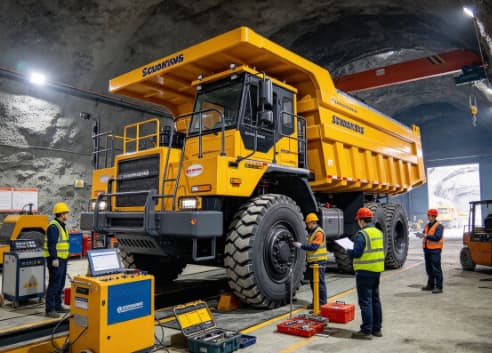
Ask the supplier how the truck will be inspected before shipment and accepted after delivery.
Useful items include:
- Factory inspection checklist
- Loaded functional test
- Brake and steering checks
- Hydraulic system checks
- Configuration verification
- Serial-number records
- Site commissioning procedure
Major OEM technical documents provide detailed model-level information and safety systems. Epiroc’s Minetruck MT42 technical specification, for example, documents capacity, braking, diagnostics, service access, and engine data. This is a useful benchmark for the kind of evidence buyers can request.
5. Evaluate Spare Parts and Service Support
For overseas procurement, parts lead time can matter as much as initial machine price.
Ask for:
- Recommended first-year spare list
- Critical parts lead times
- Wear-parts availability
- Remote troubleshooting support
- Technician response process
- Warranty claim procedure
- Training for operators and maintenance staff
A supplier that can provide the machine but cannot support common wear and service items may create avoidable downtime.
6. Review Commercial Terms With Technical Terms
Do not separate technical acceptance from payment terms.
Where appropriate, procurement teams can tie payment stages to:
- Approved final configuration
- Factory inspection
- Shipment documentation
- Delivery
- Commissioning
- Site acceptance
This keeps technical compliance visible throughout the purchase process.
7. Use a Simple Supplier Scorecard
A practical supplier scorecard can allocate weight to:
- Technical compliance
- Documentation quality
- Spare-parts support
- Warranty and service
- Reference projects
- Delivery capability
- Commercial terms
Price should remain one factor, not the only factor.
Buyers can also review About QINGDAO ALLIANCE and use the Contact / RFQ page when requesting model-specific documents and quotations.
Red Flags During Supplier Evaluation
Be cautious if a supplier:
- Uses category pages instead of model datasheets
- Changes specifications between quotation revisions without explanation
- Cannot provide dimensional drawings
- Avoids giving spare-parts lead times
- Cannot explain acceptance testing
- Makes certification claims without documents
- Quotes a truck before reviewing basic site conditions
None of these automatically proves a supplier is unsuitable, but each requires clarification before award.
Conclusion
A reliable underground mining truck supplier should provide traceable product documentation, respond to real site constraints, support testing and commissioning, and explain how parts and service will be handled after delivery.
Use the Mining Truck product range to identify equipment, then evaluate the supplier with a consistent RFQ and evidence-based scorecard.
FAQ
What should I ask an underground mining truck supplier first?
Ask for the exact model datasheet and provide your tunnel dimensions, grade, haul distance, material density, and production target.
How do I verify a supplier’s capacity claim?
Check the exact product page and datasheet for the quoted model, then make sure the same configuration appears in the quotation and purchase contract.
Should factory acceptance testing be included?
For higher-value equipment, a defined factory inspection or FAT can help verify configuration and basic functions before shipment.
What spare-parts information should be requested?
Ask for recommended startup spares, common wear parts, critical parts, normal lead times, and the process for emergency supply.
Is the lowest quotation usually the best choice?
Not necessarily. Compare documentation, site fit, service support, warranty, parts, testing, and delivery risk together with price.
References
- Mineloaders — Mining Truck Product Range
- Mineloaders — 5T Mining Transport Vehicle
- Mineloaders — About Us
- Mineloaders — Contact / RFQ
- Epiroc — Minetruck MT42 Technical Specification