Buyers usually weigh mining loader vs LHD when deciding whether a general mining loader or a purpose-built underground load-haul-dump machine better fits the job.
Both machines load and move material, but their design priorities are different. A mining loader handles stockpiles, truck loading, yard work, quarry operations, and wider mine areas. An LHD specializes in confined underground loading, hauling, and dumping.
Mining Loader: Broader Material-Handling Role
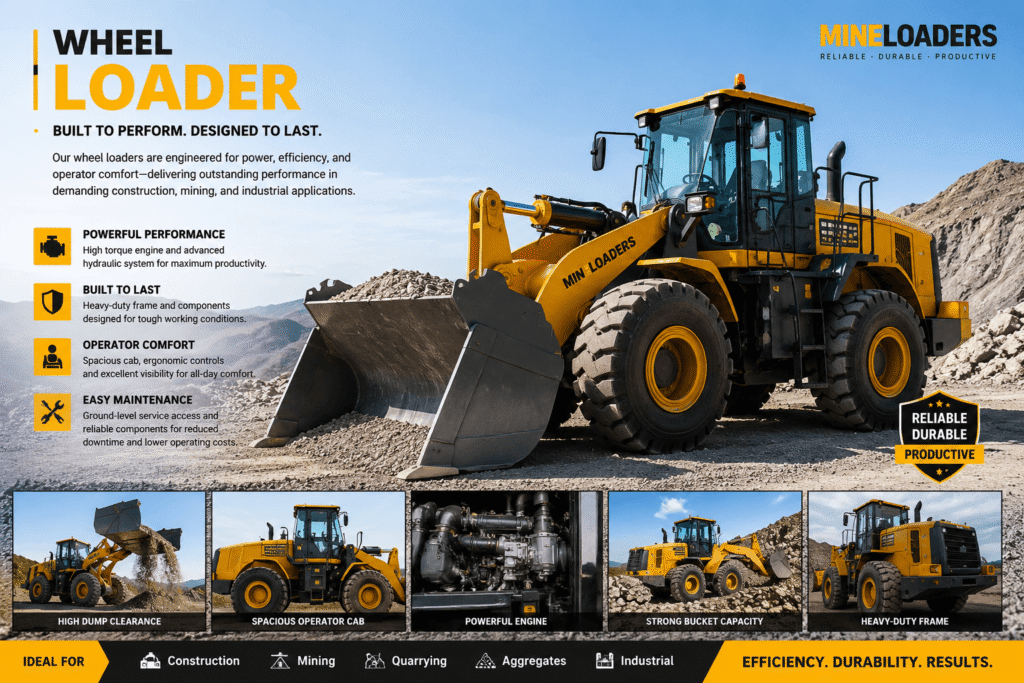
“Mining loader” is a broad commercial term. Depending on the model, it can describe heavy wheel loaders or mining-focused loaders used for:
- Loading haul trucks
- Stockpile handling
- Crusher or hopper feeding
- Yard and plant work
- Surface or wide underground areas
The Mining Loaders page includes multiple loader and transport categories, so buyers should always move from the broad category to the exact product page.
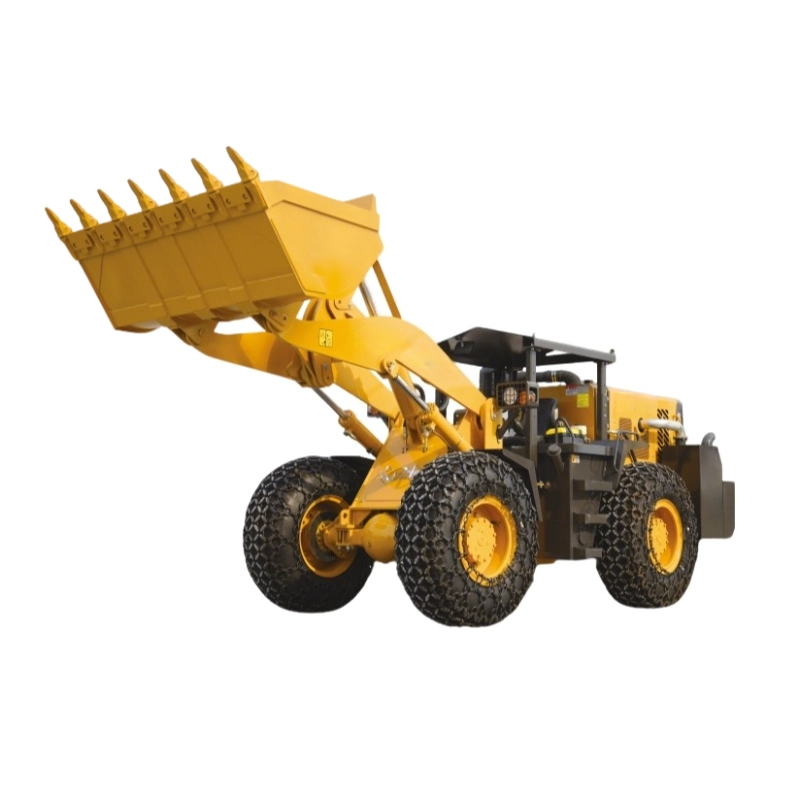
A model such as the ZL30E Loader illustrates the general-loader side of the comparison. Its product page publishes bucket capacity, rated load, dimensions, power, tire options, and available attachments for that specific model.
LHD: Designed Around Underground Load-Haul-Dump Cycles
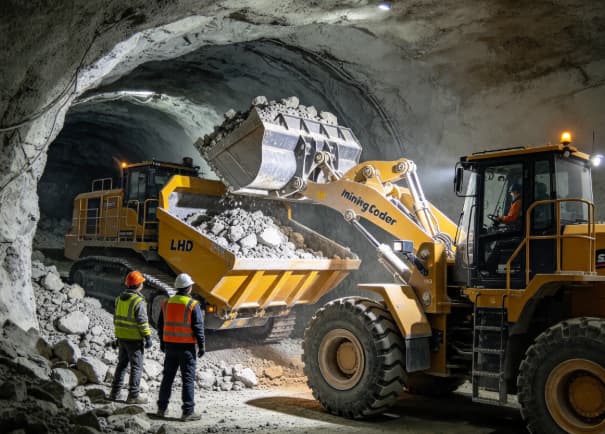
An LHD is built specifically for underground material movement.
Its priorities usually include:
- Low overall profile
- Articulated steering
- Compact turning envelope
- Strong traction on ramps
- Protected components
- High breakout capability
- Underground braking systems
- Operator visibility in confined spaces
The Underground LHD product range includes machines designed around this operating environment.
Geometry Is the Biggest Practical Difference
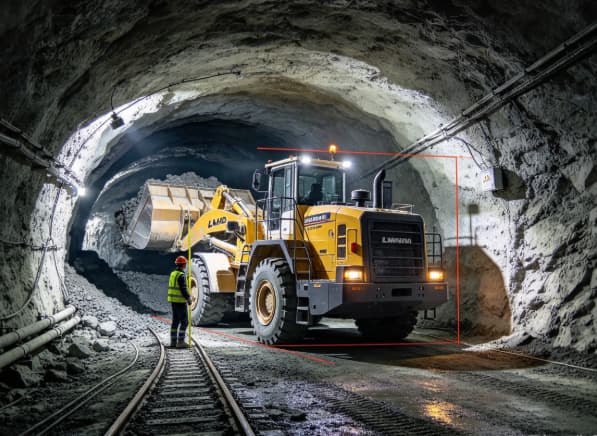
A standard or mining-focused loader often prioritizes lift height, loading reach, and general-purpose mobility. An LHD prioritizes movement through drifts and repeated face-to-dump cycles.
For underground work, compare:
- Machine height
- Width
- Turning radius
- Articulation angle
- Bucket position
- Ground clearance
- Visibility in both travel directions
Sandvik describes its underground loader range as purpose-built for hard-rock mining and offers diesel, battery-electric, cable-electric, and low-profile variants. Its underground loader range is a useful external benchmark for how strongly geometry and application influence model selection.
Haul Distance and Work Cycle
A general mining loader is often most productive when the loading point and dump or truck are relatively close.
An LHD is specifically intended to combine loading, short-haul tramming, and dumping underground.
The decision should use the actual cycle:
Load + travel loaded + dump + return
If the job is mainly truck loading or stockpile work in an open area, a mining loader may be more practical. If the machine must repeatedly tram through low, narrow headings, an LHD is usually the more relevant class to evaluate.
Payload and Bucket Selection
Neither category should be selected from bucket volume alone.
Calculate expected mass from:
Bucket volume × material density × fill factor
Then compare the result with the model-rated payload.
The Mining Loader Capacity Guide provides a more detailed method for this calculation.
Ventilation and Powertrain
Ventilation becomes a stronger selection factor as the machine moves deeper underground.
LHD ranges commonly include diesel and electric configurations because the mine may need to manage engine exhaust, heat, cable systems, charging, or electrical infrastructure.
A broad mining loader used mainly in open or well-ventilated areas may not face the same system constraints.
Maintenance and Attachments
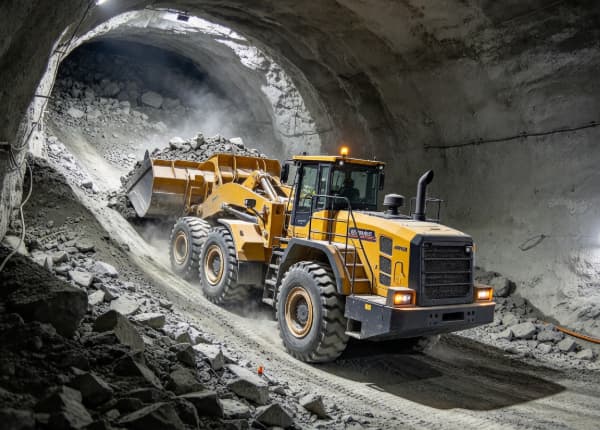
General mining loaders may offer a wider range of loading or handling attachments. LHD attachments and buckets need to be checked against underground geometry, hydraulic requirements, and rated payload.
For both categories, review:
- Maintenance access
- Parts availability
- Brake service
- Hydraulic components
- Tires
- Attachment compatibility
When to Choose a Mining Loader
A mining loader may be the better starting point when:
- The work area is open or relatively wide.
- The primary task is loading trucks or stockpiles.
- Higher dump height is important.
- The machine will perform multiple material-handling tasks.
- Underground clearance is not the main constraint.
When to Choose an LHD
An LHD may be the better starting point when:
- The machine works mainly in underground drifts.
- Low height and tight turning are critical.
- Repeated short-haul tramming is part of the cycle.
- Ramp traction and underground braking are important.
- Ventilation or electric powertrain choices influence the mine plan.
Conclusion
The mining loader vs LHD decision is mainly about operating environment and work cycle.
A mining loader offers broader material-handling flexibility, while an LHD is purpose-built for confined underground load-haul-dump work. Compare exact model dimensions, rated payload, cycle requirements, and maintenance needs before choosing between the two.Not sure which class fits your site? Send us your tunnel dimensions and cycle requirements — our team will recommend a matching model from the ZL30E series or our underground LHD range.
FAQ
Is an LHD a type of mining loader?
Yes. An LHD is a specialized underground loader designed for load-haul-dump cycles.
Can a normal mining loader be used underground?
Possibly, but only if its dimensions, ventilation implications, braking, safety configuration, and site requirements are suitable.
Which machine has a larger bucket?
There is no universal answer. Bucket size varies by model and should be compared with rated payload and material density.
Why are LHDs usually low profile?
Low-profile geometry helps them work in underground drifts where height and turning space are limited.
Which machine is better for truck loading?
A general mining loader may be better in open loading areas, while an LHD can be better when the loading cycle is inside confined underground workings.
References
- Mineloaders — Mining Loaders
- Mineloaders — Underground LHD Product Range
- Mineloaders — ZL30E Loader
- Sandvik — Underground Loader Range