Choosing between mining truck types is not simply a matter of selecting the largest payload. In mining, the labels dump truck, haul truck and transport truck often overlap, yet each label emphasizes a different part of the job: unloading, repeated production hauling, or site-specific transport. A useful comparison starts with the material to be moved, the route it must travel and the operating conditions it will face.
This guide explains the common meanings behind these terms, shows where rigid, articulated and underground machines fit, and sets out a practical buyer checklist.
Why mining truck terminology can be confusing
There is no universal rule that makes every “dump truck,” “haul truck” or “transport truck” a completely separate machine class. Manufacturers and mines commonly use the terms differently by region, application and product range. For example, Caterpillar groups its mining products as “Mining Trucks” while describing them as powerful haul trucks that move material in off-highway work.[1] Therefore, buyers should treat the name as a starting point and confirm the machine layout, rated payload, body type, route, cycle and operating environment.
In practical mining discussions, dump truck usually highlights the ability to carry loose material and discharge it by tipping the body. Haul truck usually highlights repeated load-haul-dump production cycles and cost per tonne. Transport truck is often a broader site or supplier term for a vehicle used to move material, equipment or personnel; in a mining product catalogue, it may describe compact mine-site carriers as well as larger haulage units. It should not be assumed to mean a road-legal highway truck.
Mining truck types at a glance
| Term commonly used | What the term normally emphasizes | Typical mining context | What a buyer must still confirm |
|---|---|---|---|
| Dump truck | Carrying and tipping loose material from a dump body. | Overburden, aggregate, ore, waste rock, stockpile or short mine-site movements. | Rigid or articulated chassis, body volume, payload, tipping arrangement, ground conditions and loading method. |
| Haul truck | High-utilisation production haulage in repeated cycles. | Open-pit mine routes, quarry haul roads and large-volume material movement. | Payload target, haul-road quality, distance, grade, cycle time, fuel or powertrain choice and support plan. |
| Mining transport truck / vehicle | A broader transport role, often tailored to a mine layout or a supplier’s product naming. | Compact mine-site hauling, underground or confined-area transport, and specialized material movement. | Exact payload basis, overall dimensions, clearance, emissions or power requirements, body configuration and permitted use. |
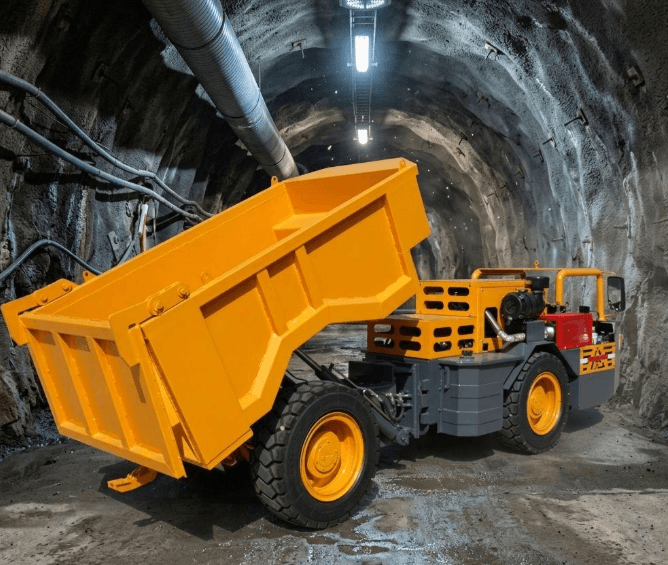
1. Dump trucks: focus on loading, carrying and discharge
A dump truck is defined operationally by its body and tipping function. It is designed to receive loose bulk material, carry it over a defined route and discharge it at a dump point, crusher, stockpile or transfer area. This description covers more than one chassis format, which is why the term alone does not identify the best machine for a mine.
Two common configurations are rigid dump trucks and articulated dump trucks. Rigid machines are generally associated with high-volume movement on prepared, consistent haul roads. Volvo notes that rigid haulers are suited to high-capacity, long-cycle production where firm, well-maintained roads support faster cycle times.[2] Articulated dump trucks are generally valued where terrain is soft, steep, variable or wet, and where site flexibility matters more than peak productivity on a purpose-built haul road.[2]
For the buyer, the key distinction is not whether the word dump appears in the product name. It is whether the truck’s articulation, suspension, tires, body and powertrain are suited to the actual loading tool, material density, road surface, gradients and dumping arrangement. A compact mine truck can be a dump truck; a very large surface hauler can also be a dump truck.
2. Haul trucks: focus on production tonnes and cycle performance
A haul truck is usually the more specific term for a machine deployed in a planned load-haul-dump cycle. In surface mining, it commonly describes a heavy off-highway vehicle that runs repeatedly between a loading face and a destination such as a crusher, waste dump or stockpile. The selection objective is not nominal payload alone. It is the amount of material the operation can move safely and consistently through the complete cycle.
When comparing mining truck types for surface production, start with the cycle. Record the loading time, travel distance, grade, rolling resistance, queue time, dumping time and return route. A large truck can be inefficient if the loading equipment cannot fill it efficiently, the road cannot support it, or the dump point creates delays. Conversely, several smaller units can be preferable where access, turning space or road conditions constrain the route.
Rigid versus articulated design is an important branch of this decision. Volvo’s selection guidance illustrates the trade-off: high-capacity rigid haulers can be effective on stable, maintained haul roads, while articulated machines may offer more mobility on poor or variable ground.[2] That comparison is application-specific rather than a universal performance promise, so actual site measurements and supplier documentation should govern the final choice.
3. Transport trucks: focus on mine layout and the supplier’s intended use
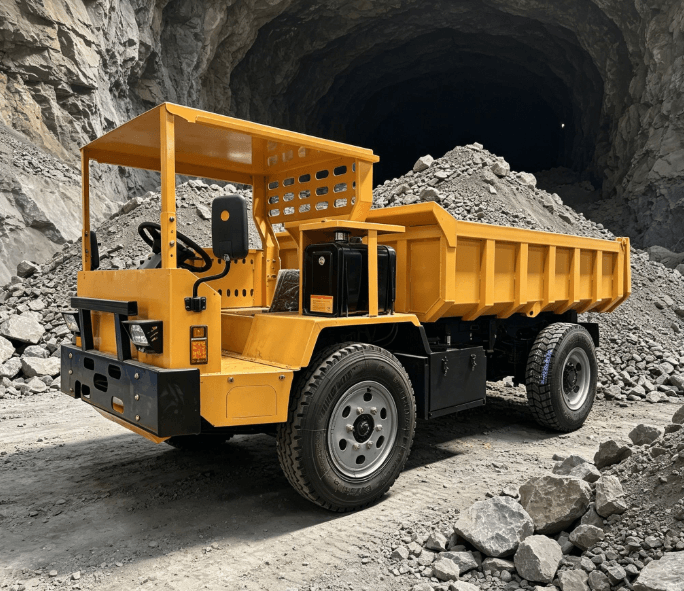
“Transport truck” is a useful but broad label. It can describe a material carrier within a mine, a compact transport vehicle for a constrained route or a supplier’s category for several payload classes. In underground mining, the term should prompt especially careful questions about clearance, drift geometry, ramp grade, turning space, ventilation constraints and the required body design.
Underground equipment is a clear example of why dimensions can matter as much as payload. Epiroc states that its underground mining truck range serves mining and tunnelling applications across different mine layouts, including narrow-vein work, and identifies compact dimensions, drift dimensions, steep ramps and heavy-duty cycles as design considerations.[3] Its example does not define every underground transport truck, but it shows why a buyer should supply route dimensions and duty data before asking for a recommendation.
On the ALLIANCE Mining Truck category, the listed mining transport vehicle labels range from 3T to 25T. This indicates a portfolio of named capacity classes, not a complete specification or a guarantee of suitability for a particular mine. Buyers should request the relevant product sheet and confirm the payload definition, dimensions, body, gradeability, operating environment and available options for the intended application.[4]
How to choose among mining truck types
A reliable selection process matches the vehicle to the operating system rather than selecting by capacity label alone. The following questions help structure an initial comparison and make supplier quotations easier to evaluate.
| Selection question | Why it changes the vehicle choice | Information to include in an RFQ |
|---|---|---|
| What material will be hauled? | Material density, fragmentation, moisture and abrasiveness affect the appropriate body volume, payload target and wear protection. | Material name, bulk density range, maximum rock size, moisture condition and target tonnes per hour. |
| Where will the truck operate? | Open-pit, quarry, tunnel and underground routes place very different demands on clearance, ventilation, traction and visibility. | Mine type, altitude, ambient conditions, route width and height, turning radius and local regulations. |
| What are the haul-road conditions? | Road firmness, rolling resistance, grades, drainage and maintenance influence the rigid-versus-articulated decision and tire strategy. | Route length, grade profile, road surface, seasonal conditions and maintenance standard. |
| How will the truck be loaded and unloaded? | Loader or excavator pass match, payload control and dump-point geometry affect cycle efficiency and operating risk. | Loading machine model, bucket size, target passes, dump-point layout and production schedule. |
| What support model is available? | Uptime depends on parts planning, service access, operator familiarisation and maintenance capability. | Operating hours, maintenance team capability, required documentation, spare-parts expectations and destination country. |
Safety, operating system and verification
Truck selection should be integrated with the mine’s operating system. NIOSH identifies haul-truck-related accidents as a significant mining safety concern and discusses interventions involving operational controls, collision-related risks, seat-belt use, automation and warning systems.[5] A product comparison cannot replace the site’s traffic plan, risk assessment, training, maintenance procedures or applicable legal requirements.
Before a purchase decision, validate the proposed configuration with the mine operator, equipment supplier and qualified safety or engineering personnel. Confirm the operating envelope, site acceptance requirements, local regulatory obligations, documentation scope and commissioning support. This approach reduces the risk of treating a catalogue term or a capacity label as proof of fitness for purpose.
Frequently asked questions about mining truck types
Is a mining dump truck the same as a haul truck?
Sometimes. A mining haul truck normally has a dump body and performs a load-haul-dump cycle, so the terms can describe the same machine. However, “dump truck” emphasizes the tipping function, while “haul truck” emphasizes production hauling. Always compare the chassis, payload, body and operating environment.
Should I choose a rigid or articulated mining truck?
The right choice depends on haul-road quality, terrain, grade, route length, production target and maintenance approach. Rigid haulers are commonly evaluated for high-volume cycles on firm, maintained roads, while articulated machines are commonly evaluated for variable or difficult ground. Site data and the supplier’s application review are essential.
What does “mining transport vehicle” mean?
It is a broad product or application label rather than a single globally standardized machine class. It may refer to a compact material carrier, an underground transport truck or another mine-site vehicle. Request the supplier’s model-specific specification and intended-use statement.
Is payload the only capacity figure that matters?
No. Payload must be considered alongside body volume, material density, loading-tool match, route geometry, cycle time, grades and availability. A truck must fit the complete operating system, not only the target load.
Next step: compare the right configuration for your mine
For an initial shortlist, review the ALLIANCE mining transport vehicle range and provide the mine type, material, target payload, route dimensions, grade, loading equipment and operating hours. A supplier can then identify a relevant model class and provide model-specific documentation for technical review.
Scope note: Final vehicle grade, dimensions, powertrain, body configuration, process behaviour, applicable documentation, availability, minimum order quantity, pricing, lead time and suitability for a specific site require confirmation with the supplier and, where appropriate, validation through engineering review, inspection or testing.
References
- Caterpillar, “Mining Trucks | Haul Trucks.” Accessed August 18, 2026.
- Volvo Construction Equipment, “How to Select the Right Mining Haul Trucks.” Accessed August 18, 2026.
- Epiroc, “Underground Mining Trucks.” Accessed August 18, 2026.
- ALLIANCE, “Mining Truck” product category. Accessed August 18, 2026.
- NIOSH, “Haul Truck Research Roadmap Report 2020.” Last reviewed January 7, 2025; accessed August 18, 2026.