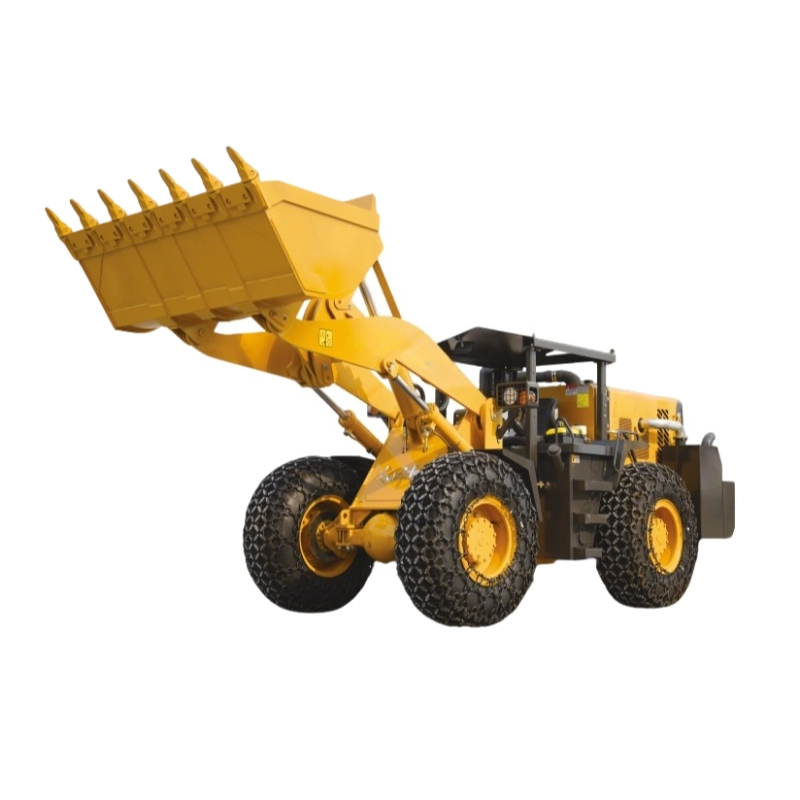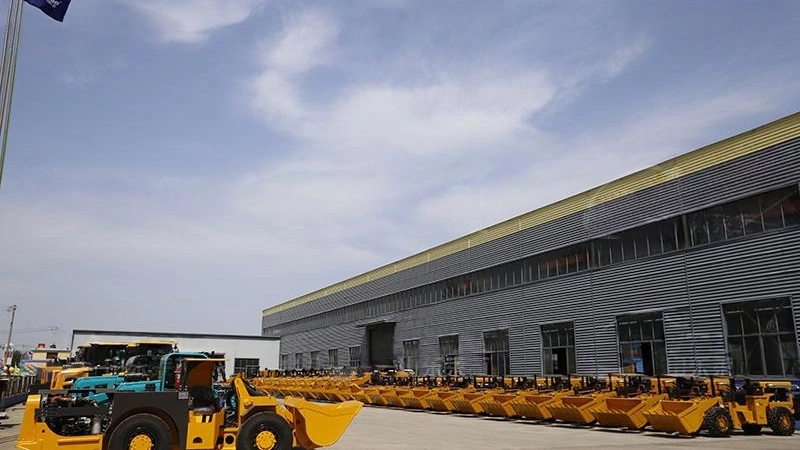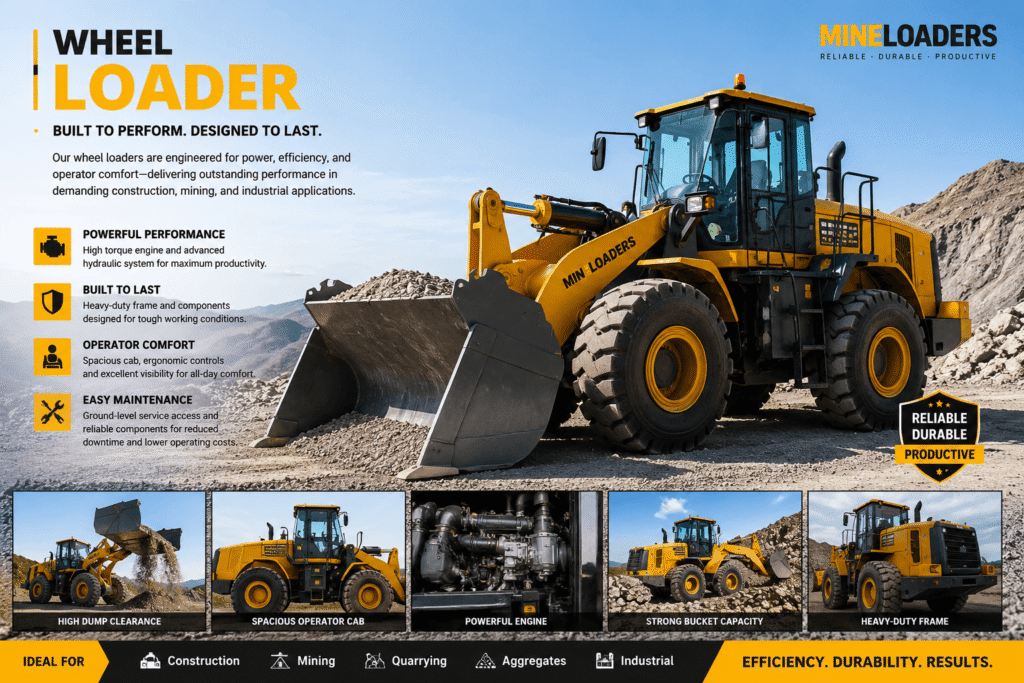
Introduction — Selecting a mining loader capacity requires balancing site-specific inputs, production targets, and machine configuration. This guide explains the technical relationships between bucket volume, payload, material properties, cycle time, and operating constraints so procurement and engineering teams can produce a defensible shortlist and RFQ requirements.
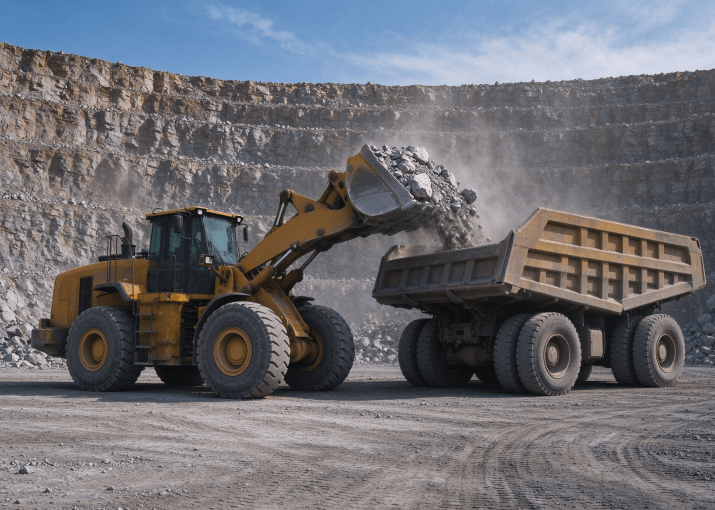
Why capacity is not a single number
Mining loader capacity refers to the combination of rated payload, effective bucket fill, and the work cycle in the intended application. Rated payload on a product sheet is a nameplate figure for a specific model and configuration. Buyers must verify rated load and full configuration with the selected model documentation and supplier[1]. Do not treat category labels alone as proof of a loader’s capacity.
Key variables that determine production
1) Bucket volume and geometry — A bucket’s cubic metres dictate theoretical material volume per pass. Bucket shape, lip design, and side slope affect bucket fill factor on different materials.
2) Material density and moisture — Bulk density (t/m³) directly converts bucket volume to mass. Moist or clayey material increases cohesive resistance and reduces fill factor and cycle time.
3) Payload rating and legal limits — The machine’s rated payload determines safe maximum carrying mass. Operating above rated values reduces component life and can breach site or regulatory limits. Confirm rated payload from the manufacturer’s product page or spec sheet before selection[1].
4) Cycle time components — Typical cycle includes fill, hoist/raise, travel loaded, dump, and return empty. Short haul distances improve effective tph (tonnes per hour). Ventilation or grade can alter travel speeds underground or on ramps.
5) Haul distance and road geometry — Longer haul distance reduces the loader’s share of production. For short shuttle distances, loaders dominate; for longer hauls, matched trucks may be more productive.
6) Site grade, traction, and braking — Uphill travel with loaded buckets increases fuel/energy use and reduces effective payload if traction limits require lighter loads. Braking and stability considerations affect safe bucket fill on slopes.
7) Tunnel or pit geometry and turning radius — Machine width, articulation, and turning radius determine how fully operators can use a bucket in constrained spaces.
8) Duty cycle and maintenance access — Higher duty cycles accelerate wear; maintenance access and downtime allowances must be included in availability factors.
9) Operator visibility and control systems — Good visibility and controls affect bucket-fill efficiency and cycle time. Operator training also matters.
10) Attachment compatibility — Different buckets, side cutters, or quick couplers change effective capacity and cycle characteristics.
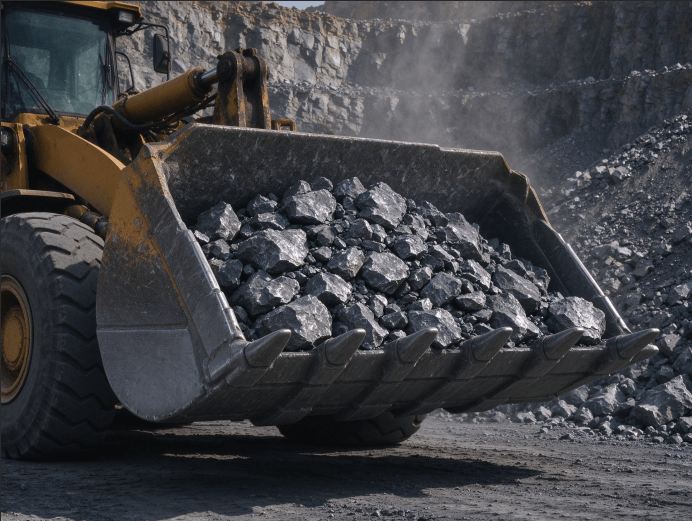
Calculation approach — from single-pass to hourly production
Step 1 — Convert bucket volume to expected payload: bucket volume (m³) × in-situ bulk density (t/m³) × expected fill factor (%) = expected payload (t).
Step 2 — Compare expected payload with the loader’s rated payload from the model spec. The selectable working payload must not exceed the machine rating. Confirm the rating from the chosen model documentation[1].
Step 3 — Estimate cycle time: measure or model fill time, lift/dump time, loaded travel time, dump, and return. Use site tests or manufacturer cycle charts when available.
Step 4 — Calculate tph: expected payload per cycle × 3600 / cycle time (s). Apply availability factor (typical 85–95% depending on maintenance strategy) to obtain realistic hourly output.
Step 5 — Run sensitivity checks for higher density, poorer fill factor, steeper grades, and longer hauls to define production ranges and risk.
Practical selection checklist (technical)
1) Specify required hourly production (tph) and operating schedule.
2) Provide accurate material properties: typical and maximum bulk density, moisture, abrasiveness.
3) Define average and maximum haul distances, grades, and tunnel/pit geometry.
4) Supply site constraints: width/height limits, ventilation (for underground), and turning radii.
5) State expected duty cycle and maintenance window targets.
6) List necessary attachments (rock buckets, side-dump, forks).
7) Request manufacturer cycle-time charts and fill-factor guidance for the bucket types considered.
8) Require rated payload, axle loads, and stability data in the RFQ. Do not accept category labels as proof of capacity — request the model spec sheet[1].
9) Ask for recommended tire/wheel, traction, and brake options for the site conditions.
10) Request test or demonstration at representative material if possible.
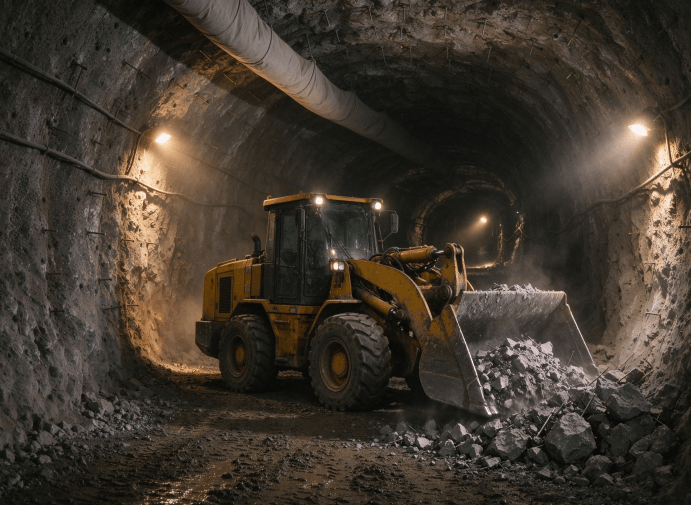
Selecting bucket types for mining tasks
- General-purpose buckets: higher fill factors on medium-density materials but not optimal for sticky clays.
- Rock or heavy-duty buckets: thicker plate, narrower profiles; designed for dense, angular rock with lower theoretical fill factor but better wear life.
- High-capacity/low-breakout buckets: larger volume for low-density materials; check rated payload compatibility before fitting.
- Side-dump or specialized buckets: useful where space or cycle-time constraints favour rapid discharge; consider operator visibility and safety.
Electric vs diesel system-level implications
When assessing electric-drive loaders versus diesel units, focus on system-level trade-offs: energy supply and infrastructure, ventilation load underground, heat rejection, charging strategy, duty-factor and cycle characteristics, and service capability for electrical components. Do not assume a product page’s category implies a particular propulsion type. Verify powertrain details on the model product page or datasheet.
Operational relationships to monitor on site
- Payload vs cycle time: aiming for maximum bucket mass may increase cycle time (slower acceleration, longer braking), reducing tph.
- Bucket fill vs material density: the same bucket delivers different mass depending on density; adjust fill strategy accordingly.
- Haul distance vs machine mix: long hauls often favour larger trucks with smaller loaders feeding them. Short hauls favour larger buckets on loaders for direct cycle productivity.
- Grade and traction: steep climbs can limit safe loaded mass; select drive and brake packages accordingly.
- Ventilation and heat: particularly for diesel units underground, plan for exhaust and heat loads in ventilation design.
Common selection errors and how to avoid them
- Error: selecting by bucket volume alone. Remedy: always convert to expected payload with site bulk density and fill factor.
- Error: assuming category or nominal class proves rated load. Remedy: demand specific model rated payload and configuration documentation[1].
- Error: neglecting cycle-time components like queuing or traffic. Remedy: model the full work cycle and include site traffic patterns.
- Error: overlooking attachment and tire effects. Remedy: specify attachments and tire types in RFQ and model their impact on effective fill and travel speed.
RFQ and supplier documentation checklist (MOFU to BOFU bridge)
- Require model-specific rated payload, bucket options with volume, and cycle-time charts.
- Request axle loads, machine dimensions (including options like safety cage or roof), and brake/steering system descriptions.
- Ask for availability of optional components (wet brakes, four-wheel drive, remote control, or protective features) and confirm with the product page where available[1][2].
- Insist on demonstration loading tests on representative material when possible.
- Specify acceptance criteria, inspection points, and spare-parts list for first 12 months of operation.
Example: Using a specific model page for verification
When a selected product page provides rated load and machine dimensions, use those figures directly and attribute them. For example, the 5T Mining Transport Vehicle product page lists a 5,000 kg rated load, 2.2 m³ hopper, and optional wet brake or four-wheel drive; purchaser must confirm configuration and option selection with the supplier[1]. Always match calculations to the actual machine configuration described on the chosen product page.
Decision process summary — 6 steps
1) Define production target and duty cycle.
2) Collect site inputs: material bulk density, haul profile, grades, geometry.
3) Convert candidate buckets to expected per-cycle payloads and compare to model-rated payload.
4) Estimate cycle time and calculate tph for each candidate.
5) Run sensitivity cases for worst-case density and grades.
6) Shortlist models and request model-specific documentation, cycle charts, and demo tests.
Closing recommendations
Use the technical checklist and decision steps to create RFQs that require model-specific rated payload and option confirmation. Avoid relying on category labels alone; verify every capacity parameter from the manufacturer’s product documentation before procurement[1]. For supplier contact and product lists, consult the mining loader category and product pages to start vendor engagement[2][3].
FAQ
Q: What is the single best number to target when specifying mining loader capacity?
A: There is no single number. Specify required hourly production, then derive the required per-cycle payload and cycle time using site bulk density and haul profile.
Q: Can I assume a loader listed in a 5t class category will have a 5,000 kg rated payload?
A: No. Category membership is not a substitute for the model spec sheet. Buyers must confirm rated payload from the specific product page or manufacturer documentation[1].
Q: How does bulk density affect bucket selection?
A: Bulk density converts bucket volume to mass. Higher density materials reduce achievable fill factor and may require smaller bucket volumes or stronger components.
Q: Should I prefer larger buckets to increase productivity?
A: Only if the expected filled mass stays within the loader’s rated payload and does not degrade cycle time or stability. Always calculate mass using real bulk density and confirm with model-rated payload.
Q: What documentation should I require in an RFQ to verify capacity?
A: Request model-rated payload, bucket volumes and types, cycle-time charts, axle loads, machine dimensions, brake and drive options, and demonstration loading results on representative material.
Q: Who should I contact at the supplier for technical clarifications?
A: For product lists and technical questions, consult the mining loader category on the site and contact details provided on the supplier’s contact page; verify configuration in writing before purchase[2][3].