Maximizing the ROI of heavy machinery depends less on the engine’s horsepower and more on the operator’s precision. In high-production environments like mining, quarrying, and large-scale construction, the difference between a skilled operator and a novice can account for a 30% variance in fuel consumption and total cycle time.
Efficient wheel loader operation is a synergy of hydraulic management, traction control, and spatial awareness. By refining specific technical habits, operators can significantly reduce “parasitic” movements that lead to unnecessary tire wear and transmission heat.

Master the Art of “Short Loading” Cycles
The most efficient path for a wheel loader is the shortest one. In most stockpiling or truck-loading applications, the “V-Shape” loading pattern remains the industry gold standard.
- The V-Pattern: Position the haul truck at a 45-degree angle to the face of the material. The loader should back out just far enough to clear the truck before turning.
- Why it works: This minimizes travel distance and reduces articulation angles. Excessive turning under load puts immense pressure on the center hitch and increases tire scrubbing.
- Technical Tip: Aim for a 1.5 to 2-turn cycle. If the loader is traveling more than two machine lengths to reach the truck, the site layout is likely costing you money in fuel and tire life.
Optimize Hydraulic Breakout Force
A common mistake is “spinning the wheels” to force the bucket into a pile. This is counterproductive and causes rapid tire degradation—one of the highest operating costs in heavy equipment.
Instead of relying solely on tractive effort (crowding the pile), use the “lift and tilt” method. As you enter the material, slightly lift the bucket arms while tilting the bucket back. This transfers the weight of the material onto the front axle, increasing traction naturally without requiring more throttle.
| Operational Action | Impact on Performance |
| Excessive Throttle | Increases fuel burn and tire slippage |
| Lift-and-Tilt Entry | Maximizes bucket fill factor and preserves tires |
| Ground Level Leveling | Ensures a clean floor for faster approach speeds |
Maintain a “Clean Floor” Strategy
Performance starts at the ground level. An operator who leaves a messy floor with spilled material creates a rolling resistance nightmare for the entire fleet.
Small rocks or uneven surfaces cause the loader to “bounce” during travel, which triggers the ride control system or, if absent, causes material spillage. Keeping the loading area flat allows the loader to maintain higher speeds safely and ensures that the haul trucks can spot correctly without damaging their tires.
Leverage Auto-Kickout and Return-to-Dig Settings
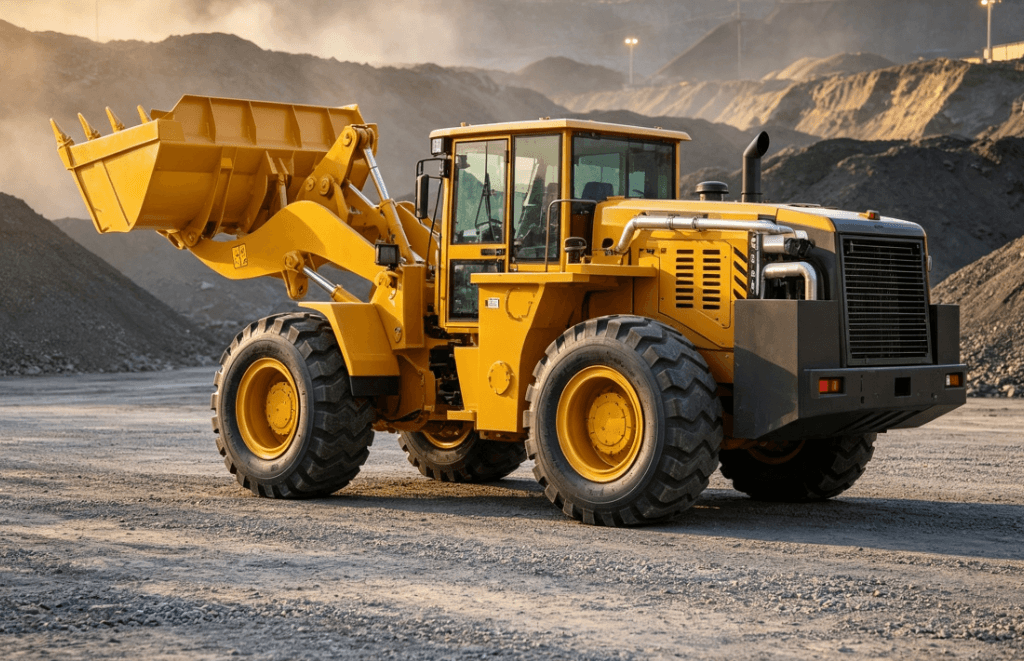
Modern wheel loaders, such as those found in professional equipment fleets, are equipped with programmable kickouts. These are not just “convenience” features; they are performance multipliers.
- Boom Height Kickout: Set the boom to stop exactly at the height needed to clear the truck’s sideboards. This prevents the operator from wasting time over-lifting.
- Return-to-Dig: This automatically brings the bucket back to a level, ready-to-load position after dumping.
- Benefit: These settings allow the operator to focus on maneuvering the machine rather than manually adjusting the bucket position, which significantly reduces mental fatigue over an 8-hour shift.
Managing Transmission and Gear Selection
Running a wheel loader in the wrong gear is a leading cause of overheating and inefficient fuel use. For most loading applications, the first gear provides the highest torque but can lead to excessive wheel spin if not managed carefully.
Many experienced operators prefer to approach the pile in second gear and downshift to first only when the extra torque is required for breakout. Furthermore, utilize the “neutralizer” or “clutch disconnect” pedal. This allows the engine’s full power to be diverted to the hydraulic system for faster lifting while the machine is stationary at the truck or pile.
Monitor Payload and Bucket Fill Factors
Overloading a bucket doesn’t always lead to higher production. If a bucket is overfilled, material spills during the travel portion of the cycle, creating a “bumpy” floor and requiring additional cleanup time.
The “Fill Factor” is the ratio of the actual material in the bucket to its rated capacity. For example, loading shot rock typically results in a 0.85 (85%) fill factor due to voids, while loose sand may result in 1.10. Understanding the density of the material you are moving helps in selecting the right bucket size for the machine’s lifting capacity, ensuring the center of gravity remains stable.
Strategic Cooling and Shutdown Procedures
Performance is also measured by machine uptime. Wheel loaders operating in high-cycle environments generate significant heat in the engine, torque converter, and braking systems.
- The Idling Myth: While excessive idling wastes fuel, shutting down a hot engine immediately after a heavy shift can cause “heat soak,” potentially damaging turbocharger bearings.
- Best Practice: Allow the engine to idle for 3–5 minutes before complete shutdown to let temperatures stabilize. Use this time to perform a quick “walk-around” to check for hydraulic leaks or tire damage.
FAQ: Wheel Loader Operation Efficiency
Q: How can I reduce fuel consumption without slowing down production?
A: Focus on reducing “empty” movements. Utilize the transmission neutralizer to keep RPMs focused on hydraulic lift rather than fighting the brakes. Also, ensure the machine is not idling for more than 5 minutes during truck delays.
Q: Why is my wheel loader experiencing excessive tire wear on the front axle?
A: This is usually caused by “spinning” into the pile. If the wheels spin, you’ve exceeded the traction limit. Use the hydraulic lift-and-tilt technique to put more downward pressure on the front tires to gain grip without spinning.
Q: When should I use the differential lock?
A: Use the diff-lock before entering slippery or soft ground. Engaging it while the wheels are already spinning at different speeds can cause significant mechanical shock to the axle components.
Q: What is the ideal angle for truck loading?
A: A 45-degree angle is generally considered ideal for the “V-loading” pattern. This balances the distance traveled with the visibility required for safe dumping.