Mining truck specifications determine whether a haulage vehicle can meet the required payload, route conditions, production target, and maintenance plan. Buyers should not compare trucks by tonnage or engine power alone. Payload, hopper volume, dimensions, gradeability, drivetrain, braking, and duty cycle need to be considered together.
Start with the Mining Truck category to identify available models. Buyers closer to purchase can use the Mining Truck for Sale guide for ordering checks, while cost-related decisions are covered separately in the Mining Truck Price Guide.
Key Mining Truck Specifications to Verify
The specification sheet should be checked against actual mine conditions rather than treated as a general performance claim.
| Specification | What to verify | Why it matters |
|---|---|---|
| Rated payload | Model-specific rated load | Determines the maximum documented carrying capacity |
| Hopper capacity | Volume, internal dimensions and discharge arrangement | Affects material volume and loading efficiency |
| Overall dimensions | Length, width, height and optional safety-cab height | Determines route, tunnel and workshop clearance |
| Wheelbase and turning space | Model dimensions and practical maneuverability | Important in restricted loading and dumping areas |
| Engine and power | Exact engine model and rated output | Influences duty-cycle capability and energy demand |
| Drive configuration | RWD, 4WD or other available options | Affects traction and site suitability |
| Gradeability | Model-specific documented value | Helps assess ramp and route requirements |
| Braking | Standard and optional braking systems | Important for loaded operation on grades |
| Ground clearance | Lowest operating clearance | Relevant on uneven mine roads |
| Service intervals | Maintenance requirements and access | Influences downtime and maintenance planning |
These parameters should come from the exact model page, datasheet, or supplier documentation rather than from a category name alone.
Rated Payload and Hopper Capacity Are Not the Same
A truck described as 5T, 10T, or another nominal class should not be selected from the label alone.
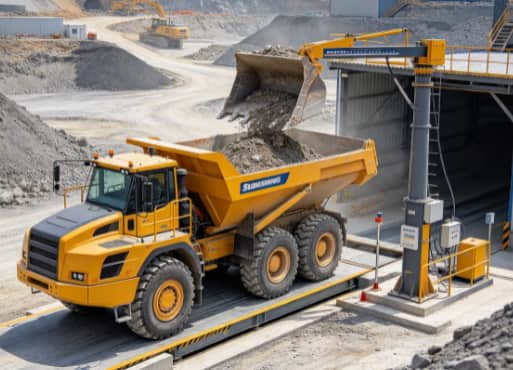
Rated payload defines the documented load limit for the specific configuration. Hopper volume describes how much material can physically fit into the body. Material density determines which limit is reached first.
For example, dense ore may reach the truck’s rated payload before the hopper is completely full. Lower-density material may fill the hopper by volume first.
This relationship is also important when calculating mining dump truck capacity. Payload, material density, cycle time, and machine availability should be evaluated together rather than independently. For more detailed capacity planning, see the Mining Dump Truck Capacity Guide.
Mining Truck Dimensions, Clearance and Route Fit
Overall length, width, height, wheelbase, and ground clearance should be checked against the actual operating route.
For underground or restricted operations, buyers should document the narrowest roadway, lowest clearance, turning points, passing areas, workshop access, and dumping location.
Optional equipment can also change the machine envelope. A safety roof or cage, for example, may increase total vehicle height even when the base model fits the route.
Do not evaluate dimensions only at the tunnel entrance. The truck also needs enough room to turn, position for loading, dump safely, and enter maintenance areas.
Powertrain, Driveline and Gradeability
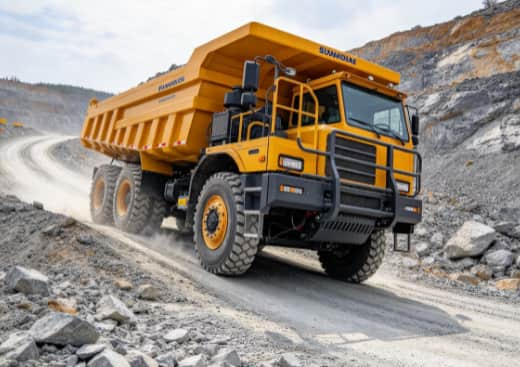
Engine power alone does not determine whether a mining truck will perform well on a given route.
Buyers should verify the engine model, gearbox, axle configuration, drive mode, documented climbing ability, tire specification, and available traction options.
Grade also changes the importance of braking and drivetrain selection. MSHA guidance for powered haulage emphasizes factors such as road conditions, grades, traffic patterns, visibility, and equipment interaction when planning haulage operations.
Where steep or long declines are involved, braking requirements should be reviewed against the actual loaded route rather than inferred from truck capacity alone.
How Specifications Affect the Haul Cycle
Mining truck productivity depends on the complete operating cycle:
Loading + loaded travel + dumping + empty return + delays
A truck with a larger rated payload does not automatically provide higher hourly production.
Tight corners, long grades, poor road conditions, traffic, loading delays, and dump-point congestion can increase cycle time enough to offset the benefit of carrying more material.
A practical planning relationship is:
Hourly moved mass = effective payload × cycles per hour × availability
The calculation should use realistic site data. Manufacturer-rated payload remains a machine limit, while actual working payload may change with material density, fill level, route conditions, and site operating rules.
5T and 10T Mining Truck Specification Examples
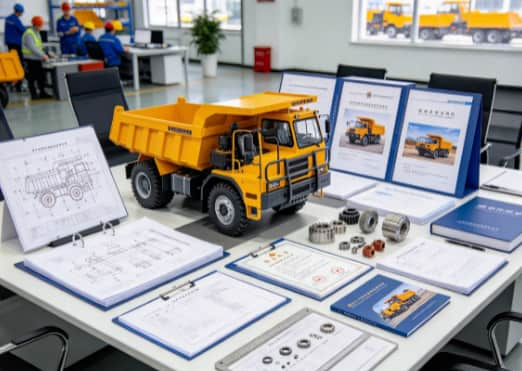
The following models show why buyers should compare complete specifications rather than capacity labels alone.
| Specification | 5T Mining Transport Vehicle | 10T Mining Transport Vehicle |
|---|---|---|
| Rated load | 5,000 kg | 10,000 kg |
| Hopper capacity | 2.2 m³ | 4 m³ |
| Hopper dimensions | 2700 × 1680 × 600 mm | 3200 × 1780 × 800 mm |
| Engine | Yunnei 490, 48 kW | Yunnei 4102 turbocharged, 81 kW |
| Gearbox | Wanliyang 530 | Wanliyang 545 |
| Drive mode | Rear-wheel drive | Rear-wheel drive |
| Climbing ability | 15° | 15° |
| Total length | 4450 mm | 5000 mm |
| Total width | 1680 mm | 1780 mm |
| Total height | 1450 mm; 1950 mm with safety cage | 1960 mm; 2050 mm with safety roof |
| Optional equipment | Wet brake, four-wheel drive | Wet brake, four-wheel drive |
These figures apply only to the named product configurations. Final specifications and optional equipment should be confirmed in the model documentation and quotation before purchase.
The comparison also shows why moving from one payload class to another affects more than carrying capacity. Vehicle width, height, hopper dimensions, engine output, and operating space may change at the same time.
Diesel and Electric Configuration Considerations
Powertrain selection should be treated as a site-level decision.
Internal-combustion equipment requires consideration of fuel supply, engine cooling, exhaust treatment, and underground ventilation. NIOSH notes that diesel-powered underground equipment contributes aerosols and gases that need to be managed through ventilation, equipment maintenance, exhaust controls, and other measures.
Electric equipment shifts part of the requirement toward charging, electrical distribution, battery management, or cable systems.
Buyers comparing these approaches can review the Diesel vs Electric Mining Equipment guide, but the final choice should still be based on duty cycle, infrastructure, route conditions, and maintenance capability.
Serviceability and Lifecycle Requirements
Mining truck specifications should also cover maintenance access.
A technically suitable truck can still create operating problems if routine service is difficult or critical parts have long lead times.
Before ordering, check access to filters, lubrication points, brakes, cooling components, hydraulic systems, tires, and other regular service items. Maintenance teams should review the proposed machine before the specification is finalized.
Parts availability and technical support should also be included in supplier evaluation. For late-stage sourcing, the Underground Mining Truck Supplier guide provides a separate framework for reviewing documentation, parts support, warranty, commissioning, and supplier capability.
Supplier Documentation to Request
Ask the supplier for:
- Model-specific specification sheet and rated payload confirmation.
- Complete dimensional drawings, including optional safety structures.
- Engine, gearbox, axle, braking, and drive-system information.
- Operating and maintenance manuals.
- Recommended spare-parts list and expected lead times.
- Available option list showing which features are standard or optional.
- Relevant certificates or test reports referenced for the exact model.
- Factory inspection or acceptance-test procedures where appropriate.
Product-category pages are useful for shortlisting machines, but they should not replace model-level documentation.
Mining Truck Specification Checklist Before RFQ Approval
| Check | Buyer action |
|---|---|
| Payload | Verify rated load from the exact model documentation |
| Hopper | Compare volume with material density and loading method |
| Dimensions | Check full vehicle envelope against the route |
| Grade | Compare documented gradeability with actual operating grades |
| Braking | Confirm standard and optional brake configuration |
| Drive system | Review RWD, 4WD and traction requirements |
| Cycle | Estimate realistic loaded and empty travel times |
| Powertrain | Assess fuel, ventilation or electrical infrastructure |
| Maintenance | Confirm service access and intervals |
| Parts | Obtain recommended spares and normal lead times |
| Certification | Request documents supporting any stated certification |
| Acceptance | Define inspection and commissioning requirements |
Common Specification Mistakes
Selecting by nominal tonnage alone is one of the most common errors. Other problems include comparing engine power without considering route grade, ignoring optional safety-roof height, treating four-wheel drive or wet brakes as standard when they are optional, and using brochure cycle times without accounting for real traffic and road conditions.
The safest procurement approach is to separate published specifications from site assumptions and require the supplier to confirm both in writing.
FAQ
Q: Does a 5T or 10T model name prove the rated payload?
No. Use the specific product page or datasheet to verify the rated load and configuration of the exact truck being quoted.
Q: Which mining truck specification should buyers check first?
Payload, overall dimensions, route grade, and hopper capacity are good starting points because they quickly determine whether a truck is practical for the intended site.
Q: How does material density affect truck selection?
Material density determines how much mass occupies the available hopper volume. Dense material may reach the truck’s rated load before the hopper is physically full.
Q: Is a larger mining truck always more productive?
No. Productivity also depends on cycle time, route geometry, loading equipment, traffic, grade, availability, and dumping conditions.
Q: What documentation should be included with a quotation?
Request the exact model specification sheet, dimensional drawing, drivetrain and braking information, maintenance requirements, option list, spare-parts information, and any referenced certification documents.
References
5T Mining Transport Vehicle — Mineloaders
10T Mining Transport Vehicle — Mineloaders
Mining Truck Category — Mineloaders
MSHA — Powered Haulage Equipment Safety Guidance.
CDC/NIOSH — Diesel Aerosols and Gases in Underground Mines.