Selecting the right mobile equipment is the cornerstone of underground mine design and operational productivity. While both Load-Haul-Dump (LHD) machines and underground articulated trucks are essential to the material handling cycle, they serve distinct roles defined by haul distance, tunnel geometry, and payload requirements.
The fundamental difference lies in versatility versus specialization. An LHD is a multi-purpose vehicle designed to load, transport, and dump material over short distances. In contrast, an underground truck is a dedicated hauling unit that requires external loading—typically by an LHD—but offers significantly higher capacities for long-distance transport to the surface or a primary crusher.
Functional Engineering: Defining the LHD and the Truck
In the underground environment, space is the primary constraint. Engineers must balance equipment size with the “envelope” of the drift (the tunnel).
Underground LHD (Load-Haul-Dump):
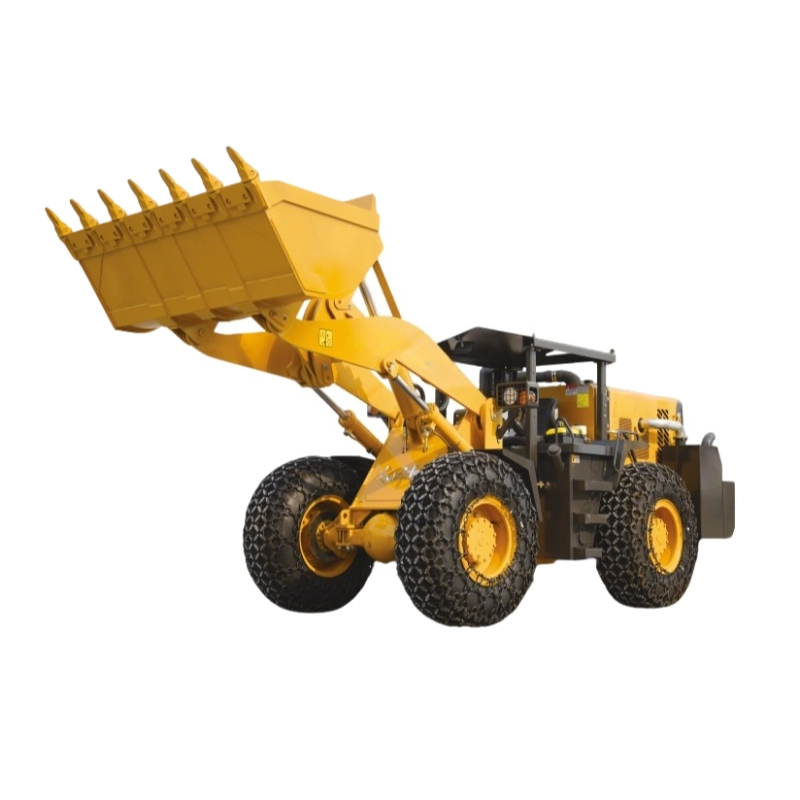
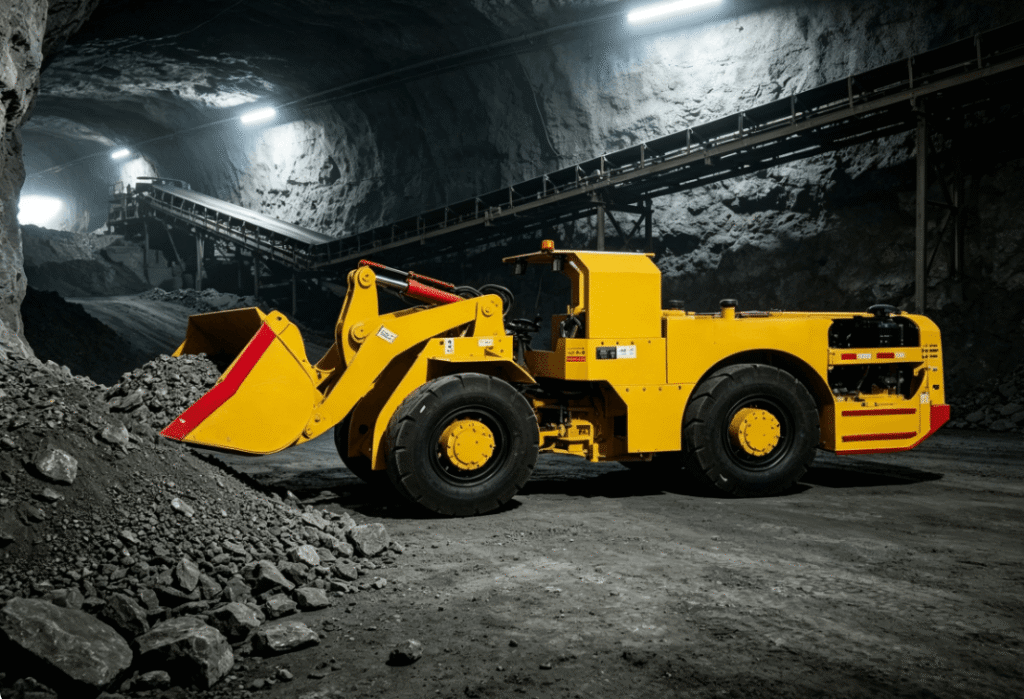
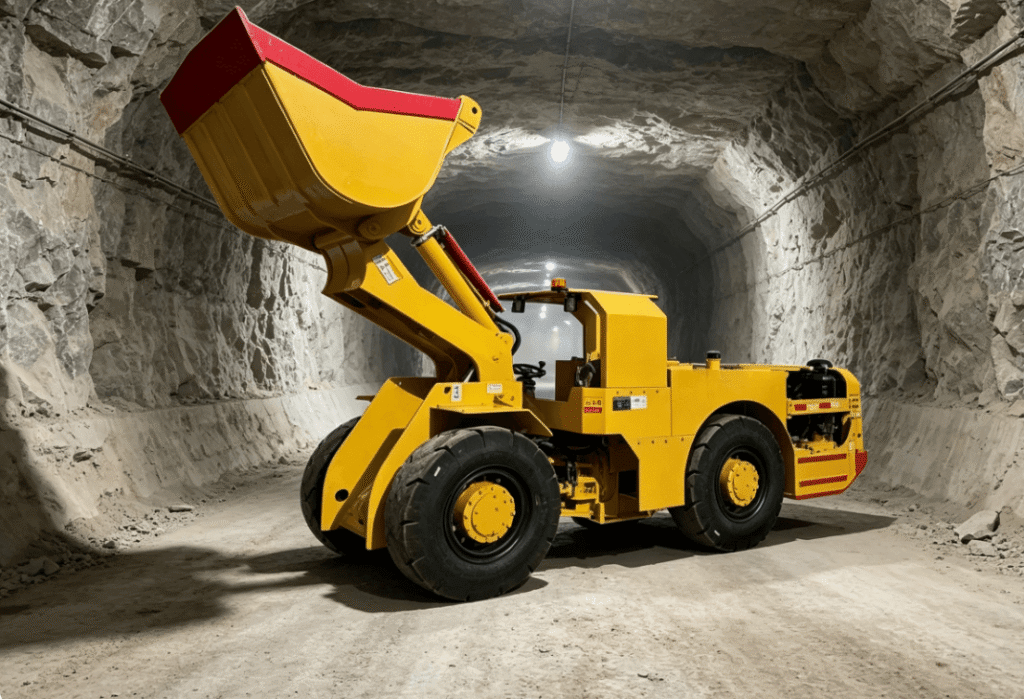
Often referred to as “scooptrams” or “muckers,” LHDs are characterized by their low profile and articulated steering. They utilize a front-mounted bucket to “muck” (collect) blasted rock directly from the face. Modern units, such as those found in the Underground LHD category, are engineered with high breakout forces and compact frames to navigate tight headings while maintaining high tramming speeds.
Underground Articulated Truck:
These are the heavy lifters of the mine. Unlike surface trucks, underground versions are narrower and lower to clear tunnel roofs. They do not have loading capabilities; they remain stationary while an LHD or a dedicated loader fills their dump body. Their engineering focus is on powertrain cooling and suspension to handle massive payloads over steep internal ramps.
Technical Comparison: LHD vs. Underground Truck
| Feature | Underground LHD (Loader) | Underground Haul Truck |
| Primary Function | Excavating, loading, and short-haul transport. | Dedicated high-volume hauling. |
| Optimal Haul Distance | Short (typically < 300 meters). | Long (typically > 300 meters to several kilometers). |
| Payload Capacity | Lower (typically 1 to 25 tonnes). | Higher (typically 20 to 65+ tonnes). |
| Maneuverability | Excellent; designed for tight 90-degree turns. | Moderate; requires wider turning radii. |
| Operator Orientation | Often side-seated for bi-directional visibility. | Forward-facing for long-distance tramming. |
| Loading Method | Self-loading (bucket). | Requires external loader (LHD or Excavator). |
The “Critical Distance” Rule in Mining Logistics
One of the most frequent questions project managers face is when to stop hauling with an LHD and start using a truck. In the industry, this is governed by the “Critical Haul Distance.”
When the “mucking” face is close to the ore pass or the stockpile (usually under 150–300 meters), an LHD is the most efficient tool. Because it loads itself, there is no “wait time” for a second vehicle.
However, as the mine expands and the distance to the dump point increases, the LHD’s cycle time becomes inefficient. Its bucket capacity is small compared to its fuel consumption over long distances. This is where the LHD-to-Truck Handover occurs. In this scenario, the LHD stays at the face, performing the loading, while two or three trucks manage the long-distance transport. This “fleet matching” ensures that the expensive LHD is always moving rock, not spending 80% of its time driving back and forth.
Tunnel Geometry and Ventilation Constraints
Engineering a mine fleet requires a deep dive into the geotechnical and environmental limits of the site.
1. Drift Dimensions
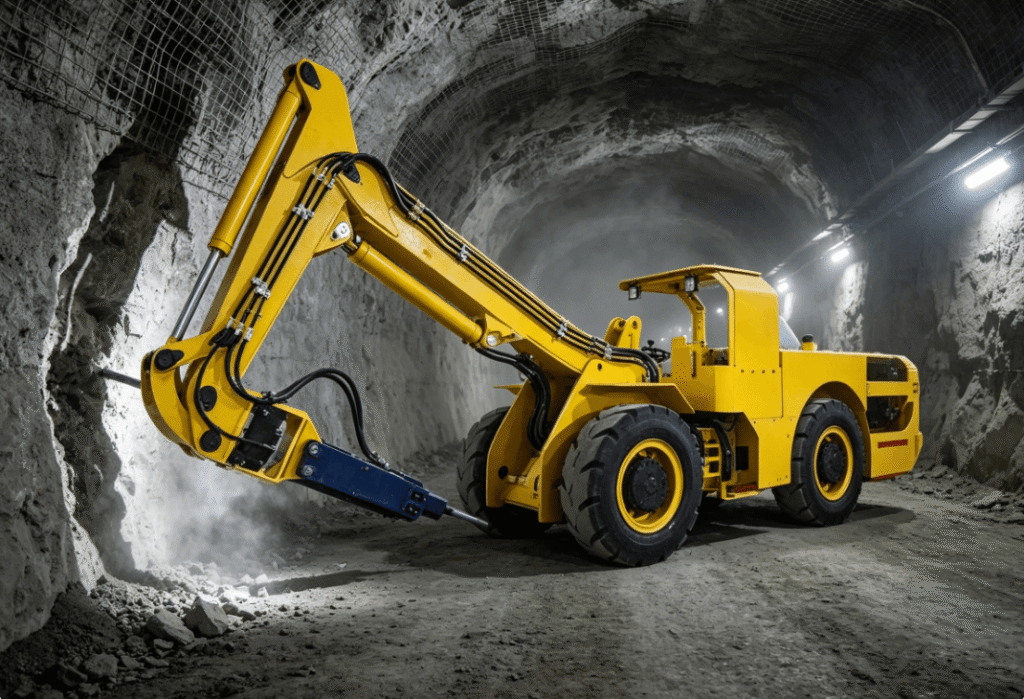
LHDs are designed with a “low-profile” architecture. A 14-tonne LHD can often operate in a much smaller heading than a 30-tonne truck. If the mine plan calls for narrow-vein mining, an LHD-only fleet might be the only viable option. Utilizing trucks requires widening the drifts, which increases development costs and may compromise rock mass stability.
2. Ventilation Requirements
Diesel engines in confined spaces require massive amounts of airflow to dilute particulate matter and NOx emissions. Underground trucks, having larger engines to move 60-tonne payloads up 15% grades, place a significant load on the mine’s ventilation system. Engineers must calculate whether the existing fans can support a truck fleet or if a transition to Battery Electric Vehicles (BEVs) is necessary to reduce the heat and emission load.
3. Road Maintenance
LHDs have a shorter wheelbase and different weight distribution compared to trucks. Heavy haul trucks exert immense pressure on the “mine floor” (the sill). Implementing a truck fleet often requires higher-quality road base and frequent grading to prevent tire damage—one of the highest Opex costs in underground mining.
Operational Synergy: The Loading Pocket
In a standard MOFU (Middle of Funnel) evaluation, it is rarely a choice of one or the other, but rather how they pair. A common high-efficiency configuration involves:
- The LHD: Operates in the “mucking” bay, scooping material and retreating to a wider section of the tunnel called a “loading pocket.”
- The Truck: Backs into the loading pocket. The LHD dumps 3 to 5 bucket loads into the truck’s tray.
- The Cycle: The truck departs for the surface, and the LHD immediately returns to the face to continue mucking.
This synergy maximizes the “Tonnes per Hour” (TPH) metric, which is the ultimate KPI for any underground operation.
Choosing the Right Equipment for Your Project
When evaluating equipment from specialized providers like Mineloaders.com, consider these three decision drivers:
- Production Scale: Small-scale exploration or narrow-vein mines usually rely exclusively on LHDs. Large-scale block caving or room-and-pillar operations require a combined fleet.
- Gradient (Incline): If the ore must be moved up a steep ramp to the surface, trucks are significantly more cost-effective due to their specialized transmissions and torque curves.
- Capital vs. Operating Cost: LHDs have a lower initial purchase price than large trucks, but their operating cost per tonne increases exponentially with distance.
The Future: Automation and Electrification
The gap between LHDs and trucks is narrowing through technology. Autonomous tramming allows LHDs to operate during shift changes (when smoke is clearing), potentially extending their effective haul distance. Furthermore, the rise of Electric LHDs is allowing mines to operate in deeper, hotter environments where traditional diesel trucks would require impossible amounts of cooling.
FAQ
Q: Can an LHD replace an underground truck entirely?
A: Only in small-scale operations or when the haul distance is very short (under 200m). For any high-volume mine with long transport routes, the cost-per-tonne of using an LHD for hauling is prohibitively high.
Q: What is the average lifespan of an underground LHD compared to a truck?
A: Both typically see a “major mid-life rebuild” at 5,000 to 8,000 hours. However, LHDs often experience more structural wear on the front frame and bucket linkage due to the high-impact nature of “digging” into blasted rock.
Q: Are tires interchangeable between LHDs and trucks?
A: Generally, no. LHD tires are designed for high torque and puncture resistance in the “muck pile,” often featuring smooth treads (L5S). Truck tires are designed for heat dissipation and traction during long-distance tramming.
Q: How do I determine how many trucks I need for one LHD?
A: This is calculated using a “Match Factor.” You divide the truck cycle time by the LHD loading time. A match factor of 1.0 means neither machine is waiting for the other.
Reference Sources:
- MSHA (Mine Safety and Health Administration): Safety standards for underground mobile equipment ventilation and braking.
- CIM (Canadian Institute of Mining, Metallurgy and Petroleum): Best practices for underground haulage and fleet optimization.
- ISO 19296: Mining — Mobile machines working underground — Machine safety.
- Technical Specification Sheets: Industry-standard parameters for underground loaders and articulated haulers.