Underground LHD specifications should be read as a connected system, not as isolated numbers. A loader with the right nominal payload can still be a poor fit if its turning envelope, bucket configuration, braking system, or maintenance access does not match the mine.
For buyers building a shortlist, start with the Underground LHD product range and verify each candidate at model level. Category names are useful for discovery, but final procurement decisions should use the exact product page and technical datasheet.
Rated Payload and Bucket Capacity
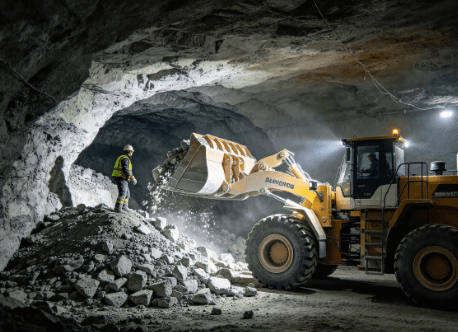
Rated payload defines the manufacturer’s stated carrying limit for a specific configuration. Bucket volume determines how much material can be loaded geometrically, but actual payload also depends on material density and fill factor.
A practical estimate is:
Expected payload = bucket volume × material density × fill factor
This is why a larger bucket does not automatically improve output. Dense ore can reach the rated payload before the bucket is full, while lighter material may need more volume to use the machine’s capacity effectively.
The existing Mining Loader Capacity Guide can be used for detailed payload calculations without turning this article into another capacity guide.
Machine Dimensions and Turning Envelope
For underground applications, dimensions often eliminate unsuitable models before power or bucket size becomes relevant.
Confirm:
- Overall length, width, and height
- Transport dimensions
- Ground clearance
- Wheelbase
- Inner and outer turning radius
- Articulation angle
- Service clearance around the machine
Compare these values with the narrowest drift, crosscut, loading bay, maintenance area, and ramp.
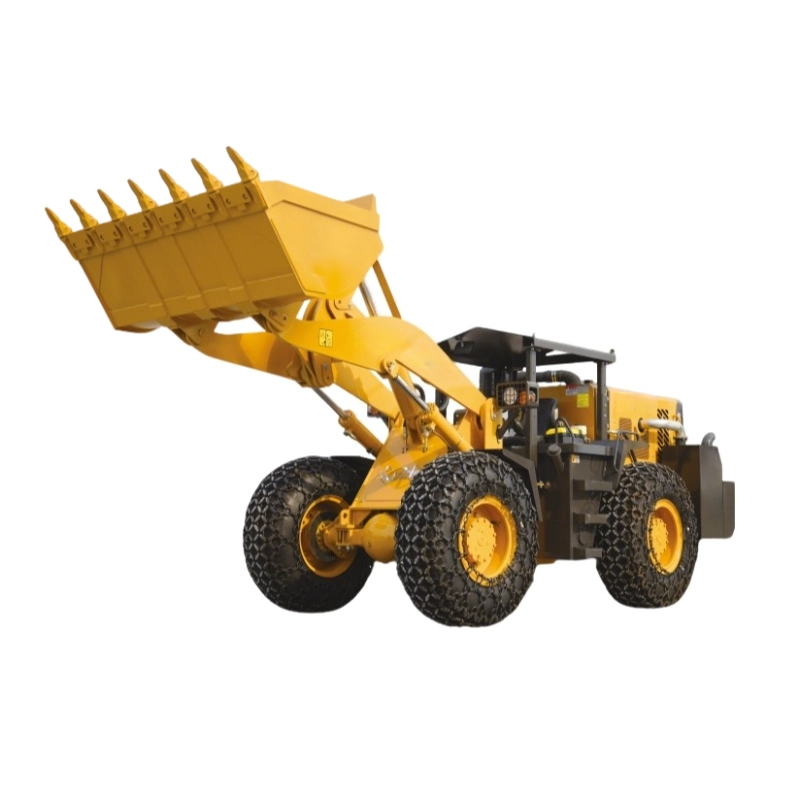
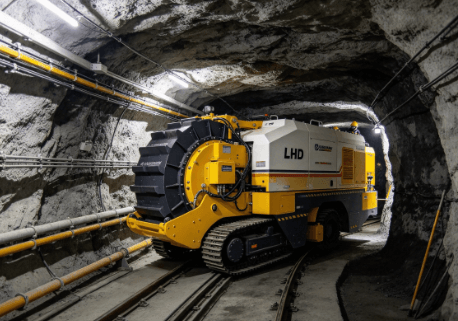
The WJ-2 Underground Internal Combustion Scraper is an example of why model-level data matters: its product page publishes rated load, bucket capacity, overall dimensions, turning radius, drive mode, and braking system for that named machine. Those numbers should not be generalized to other LHDs.
Traction, Gradeability, and Braking
Underground LHDs frequently work on ramps, uneven floors, wet sections, and repeated load-haul-dump cycles. Buyers should therefore compare traction and braking together.
Request:
- Maximum recommended grade
- Drive arrangement
- Tractive effort where available
- Service and parking brake configuration
- Retarding capability if applicable
- Tire specification and optional protection
For a useful benchmark, Sandvik’s Toro LH410 publishes capacity, bucket range, dimensions, operating weight, and other model-level specifications. Epiroc’s Scooptram ST14 technical specification also shows turning geometry, bucket options, and grade-performance information. These are useful examples of the documentation depth buyers should request.
Powertrain and Ventilation Impact
Powertrain affects infrastructure as well as machine performance.
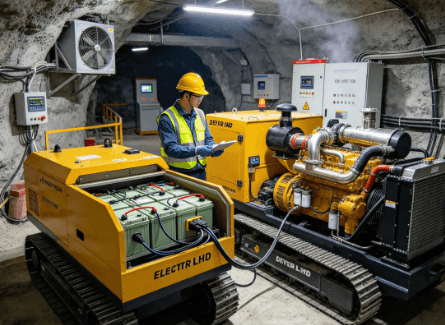
For internal-combustion LHDs, buyers should consider ventilation, heat rejection, fuel logistics, and exhaust treatment. For electric machines, check whether the system is cable-electric or battery-electric, then review power supply, charging or cable management, and electrical maintenance requirements.
Do not let this section replace a dedicated electric-versus-diesel comparison. Here, the purpose is only to confirm that powertrain data is included in the specification review.
Mineloaders currently lists both internal-combustion models such as the WJ-1 Underground Internal Combustion Scraper and electric equipment such as the WJD-1 Underground Electric Scraper. Their product pages should be treated as model-specific references.
Serviceability and Maintenance Access
Specifications should also tell the maintenance team how the machine will be supported after delivery.
Check:
- Filter and lubrication-point access
- Hydraulic service points
- Brake inspection access
- Diagnostic interfaces
- Recommended service intervals
- Parts catalogue availability
- Critical spare-parts lead times
A machine that is difficult to service in the available workshop can lose availability even if its production specifications appear strong.
What to Request in the RFQ
For each shortlisted LHD, request the same information:
- Model-specific datasheet
- Rated payload and bucket options
- Complete dimensional drawing
- Turning and articulation data
- Braking and traction information
- Powertrain and ventilation or electrical requirements
- Maintenance schedule and recommended spares
- Available safety options and certificates
- FAT or site-test procedure where applicable
Using the same checklist for every supplier makes technical comparison more consistent.
Conclusion
The most useful underground LHD specifications are the ones that can be matched directly to the mine’s geometry, material, grade, duty cycle, and maintenance resources. Compare payload, bucket, dimensions, turning, braking, powertrain, and serviceability together rather than selecting a machine from one headline number.
Use the Underground LHD product range to build a shortlist, then verify each figure from the selected model’s documentation.
FAQ
Which underground LHD specification should buyers check first?
Start with physical fit and rated payload. If the machine does not fit the drift or cannot safely carry the required load, other specifications are secondary.
Is bucket capacity the same as payload?
No. Bucket capacity is volume; payload is mass. Material density and bucket fill factor determine how the two relate.
Why is turning radius important for an LHD?
Turning radius affects maneuverability in drifts, crosscuts, loading areas, and dump points. A machine that is too large for the route can increase cycle time or become unsuitable.
Should electric and diesel LHD specifications be compared directly?
Yes, but include infrastructure requirements. Electric models need electrical or charging planning, while diesel models require fuel, exhaust, heat, and ventilation planning.
What documents should be requested before purchase?
At minimum, request the model datasheet, dimensional drawing, maintenance schedule, parts list, braking information, and any certificates claimed for the exact model.